The term immersive is frequently thrown around when describing video games--especially by individuals not professionally engaged in scholarly study of games. From a genre standpoint, the term "immersive game" can be used interchangeably with alternate reality game (see Dave Szulborski's site/book) to refer to those cross media, collective intelligence performance/puzzle games. I do not, however, intend to delve into this form of gaming. I instead refer to the more informal adjectival form of the word, used to denote how "into" the game a player gets, or better yet, the degree to which the player's consciousness of interacting with a machine slips below his/her consciousness of being engaged in a game/story/world.
If we take this form of 'immersion' to mean the ease with which a player slips into the make believe of the video game--that events on the screen are just as real as events in the physical world (i.e., the actions of the player), then a few possibilities arise to help understand what makes a game immersive.
First, there are the obvious issues of human interface with the game--the heads up display, the load screens, and the analog to digital conversion of human action into virtual display. These issues offer very minor breaks or dampers to the immersiveness of a game--many players simply look past the interface displays and meters, while others remain fully aware of them, using them to succeed in the gameplay itself. Load screens and breaks in action can be forgotten or used as pacing mechanisms to give the game structure. Certain games which strip away these structures (in some cases as instances of cinema envy) can create a more immersive in game experience--not having to pause for a load screen or see gauges and meters enables the players to hone in on the action on screen, to more fully commit to the make believe of the game. In general, however, the immersiveness of a game seems to lie beyond the simple issue of human interface display--in fact, most gamers are completely used to the display as a given in video games, and still find themselves giving in to the imagined reality of the game.
"Immersive" is also a word frequently used to describe games with strong sensory appeal--the creation of realistic, or at least skillfully crafted sensory feedback. Well integrated visuals, music, sound effects, and haptic feedback all help to break down the "fourth wall" of the videoscreen and blend occurrences in the virtual and physical worlds. Users become surrounded (almost literally, in the case of Virtual Reality games) by sensory replications of the game world.
Further, games can be immersive in the imaginative (fictional?) worlds or universes that they create--for example, World Of Warcraft's systems of elves, dwarves, mages, skills, powers, abilities, quests, items, and magical beasts. Players devote themselves to the make believe of these worlds; fully aware that the locations and their rules are imagined, players accept them as an alternate virtual reality with which they are engaged. Players become immersed in the legend, lore, tips and tricks of the game not simply embedded in the software but as they flow out into the game's paratextual universe--the discussion boards, chat rooms, and devoted websites filled with player-created fictional and game-related content. Furthermore, fan fiction and designer-created fiction expands the boundaries of the fictional world of the game. Immersed players delve deeply not just into the storylines of the game, but into the full potential of the fictional gameworld.
But what about a rhythm game like Guitar Hero? The game lacks a storyline and has a limited fictional world--simply the creatively decorated stages unlocked by successfully playing increasingly difficult songs. Furthermore, the game has a very prominent visual interface; a guitar neck dominates the lower half of the screen, as colored circles representing notes to be played by pressing the corresponding guitar controller button descend to the bottom. But despite the interface and the very limited "game world," Guitar Hero is also a strongly immersive game experience. The controller, which is housed in a replica 3/4ths size guitar, consists of 5 fret buttons which must be held while pressing the strum bar, is a haptic simulation of playing a real electric guitar. When combined with the sensory experience of hearing music which corresponds with player action (including mistakes), the game becomes an immersive musical experience. The use of the whammy bar, which allows the player to add their own tremolo and note bends, simulates the feeling of producing a unique piece of music. Guitar Hero is immersive in the same way that using the Wiimote, light guns, steering wheels or flight joysticks imitates the haptic sensation of the real physical motion.
Tuesday, March 27, 2007

Sunday, March 18, 2007
Collective/Artificial Intelligence
I stumbled onto an interesting device a few months ago, which, in relation to our discussion of the collective intelligence embodied in the concept of Web 2.0 and the ilovebees ARG, seems interestingly relevant to our class. Google Talk, programmed by Google researcher Douwe Osinga and available on his website (unfortunately, the website is down at the moment of writing--check out his blog instead) generates text from Google search results. The user enters a phrase (usually the beginning of a sentence, like "A bird in the hand is") and the device completes the phrase with the most common subsequent word in the search results (in this case "worth"). After dropping the first word in the phrase, the device repeats the process infinitely, producing a potentially endless stream of 'consciousness' coming from Google searches. Indi Samarajiva's article about Onsinga's devices includes a pretty representative example of the device's output: beginning with "jesus will return," Google responded with "to Kings Associated Press July End did did Nature build the worlds largest Sex personals site!" The response indicates both the achievements and shortcomings of the device--it sometimes reveals how words are most frequently combined throughout the internet, in this case to advertise a pornographic personals site, but other times it produces random gibberish from the uncountable quantity of words on the Internet.
Osinga's device runs off the collected intelligence of the pages of the internet. Admittedly un-intelligent at this point, the device manages to generate text from the massive production of language by every contributor to the internet. It depends on the multi-user production of internet texts--the definitive quality of Web 2.0. Obviously, the device most successfully completes cliches because of their frequent use. However, in general, the device still produces intelligible language. In a way, the device allows Google to speak--it independently constructs new texts from limited user input. However, without the capacity to learn the rules of language from its continued inputs and outputs, the device will remain un-intelligent. In the attempt to create natural-language searches and user-interfaces in general, the ability to create unique verbal output in response to verbal input represents an important step toward mergent behavior. The goal, it seems, would be to creation Google dialogue--a technology which combines chat-bot and internet searching capability which can not only process natural language inputs, but produce natural language outputs from the searched documents. The interesting thing is that, by combining the user-created texts on searched websites into an approximate natural-language response, the device would potentially be putting individual users into a single dialogue with millions of web contributors. The device, if it could learn the appropriate behaviors, could possibly distill the collective intelligence of the internet into an artificial intelligence that "talks" to individual users.
Beyond the incredible potential for information gathering such an interface would create, it could represent a new step for the goal of AI--rather than programming all the processes of one human brain into a single computer, perhaps AI would process and reformat the collected human intelligence already found on the internet.
Osinga's device runs off the collected intelligence of the pages of the internet. Admittedly un-intelligent at this point, the device manages to generate text from the massive production of language by every contributor to the internet. It depends on the multi-user production of internet texts--the definitive quality of Web 2.0. Obviously, the device most successfully completes cliches because of their frequent use. However, in general, the device still produces intelligible language. In a way, the device allows Google to speak--it independently constructs new texts from limited user input. However, without the capacity to learn the rules of language from its continued inputs and outputs, the device will remain un-intelligent. In the attempt to create natural-language searches and user-interfaces in general, the ability to create unique verbal output in response to verbal input represents an important step toward mergent behavior. The goal, it seems, would be to creation Google dialogue--a technology which combines chat-bot and internet searching capability which can not only process natural language inputs, but produce natural language outputs from the searched documents. The interesting thing is that, by combining the user-created texts on searched websites into an approximate natural-language response, the device would potentially be putting individual users into a single dialogue with millions of web contributors. The device, if it could learn the appropriate behaviors, could possibly distill the collective intelligence of the internet into an artificial intelligence that "talks" to individual users.
Beyond the incredible potential for information gathering such an interface would create, it could represent a new step for the goal of AI--rather than programming all the processes of one human brain into a single computer, perhaps AI would process and reformat the collected human intelligence already found on the internet.


Sunday, March 11, 2007
The Stigma of the Video Game Aesthetic
Perhaps because it is so visually arresting, the recent Frank Miller graphic novel-film 300 has attracted the attention of moviegoers and critics. Generally, moviegoers seem to enjoy the film, as it skyrocketed to number one this weekend and could go on to be the biggest March opening ever. Personally, I left the theatre astounded and electrified by the gut-wrenching action, surreal visuals, and the general heroism of the plot. However, critics have given the film a mixed bag--some love it for the same reasons I did, others despise the graphic violence and sparse (spartan?) dialogue. Nearly all reviews I read contained some form of the caveat: the film is entertaining, mildly artistic, but unworthy of real respect. 300 has been variously lambasted for the acting, the surreal presentation of history, graphic content, and supposed homophobia/racism. Such things are to be expected about a movie so extremely different from what Hollywood has generated this year.
However, a few prominent critics have been sure to comment on the film's supposed video-game-like qualities: the fantastical computer-generated environments, stylized violence, and action-oriented plot, among others. Unfortunately, the comparisons of 300 to a video game tend to be pejorative rather than praising. Based on these seemingly passive and casual references to video games it is clear at least within the realm of cinema critique that video games are viewed as an inferior art form, and therefore a film which evokes the look and feel of a video game is inferior as well. For example, the LA Times author Kenneth Turan wrote, "unless you love violence as much as a Spartan, Quentin Tarantino or a video-game-playing teenage boy, you will not be endlessly fascinated." The New York Times's A.O. Scott said,
"I would happily pay a nickel less, in quarters or arcade tokens, for a vigorous 10-minute session with the video game that “300” aspires to become."

300 certainly does evoke the look and feel of a video game. Immediately, the immense, detailed, and eye-popping computer generated environments and characters evoke the feeling of an elaborate and massive video game. This is unsurprising, as similar technology is used to create both. However, many shots in 300, including those adapted from the graphic novel, resemble the close, over-the-shoulder look of 3rd-person action games. This is especially true in the film's battle scenes, which frequently follow one or two Spartans through poetically choreographed fights. The violence in the film is depicted, for lack of a better word, artistically--even when depicting brutal death, the film emphasizes the grace of the human body and the hypnotic appearance of fluid (in this case blood) in motion. While this may not necessarily be true for all video games, it is true that video games are designed to capture bodies in motion accurately and beautifully.
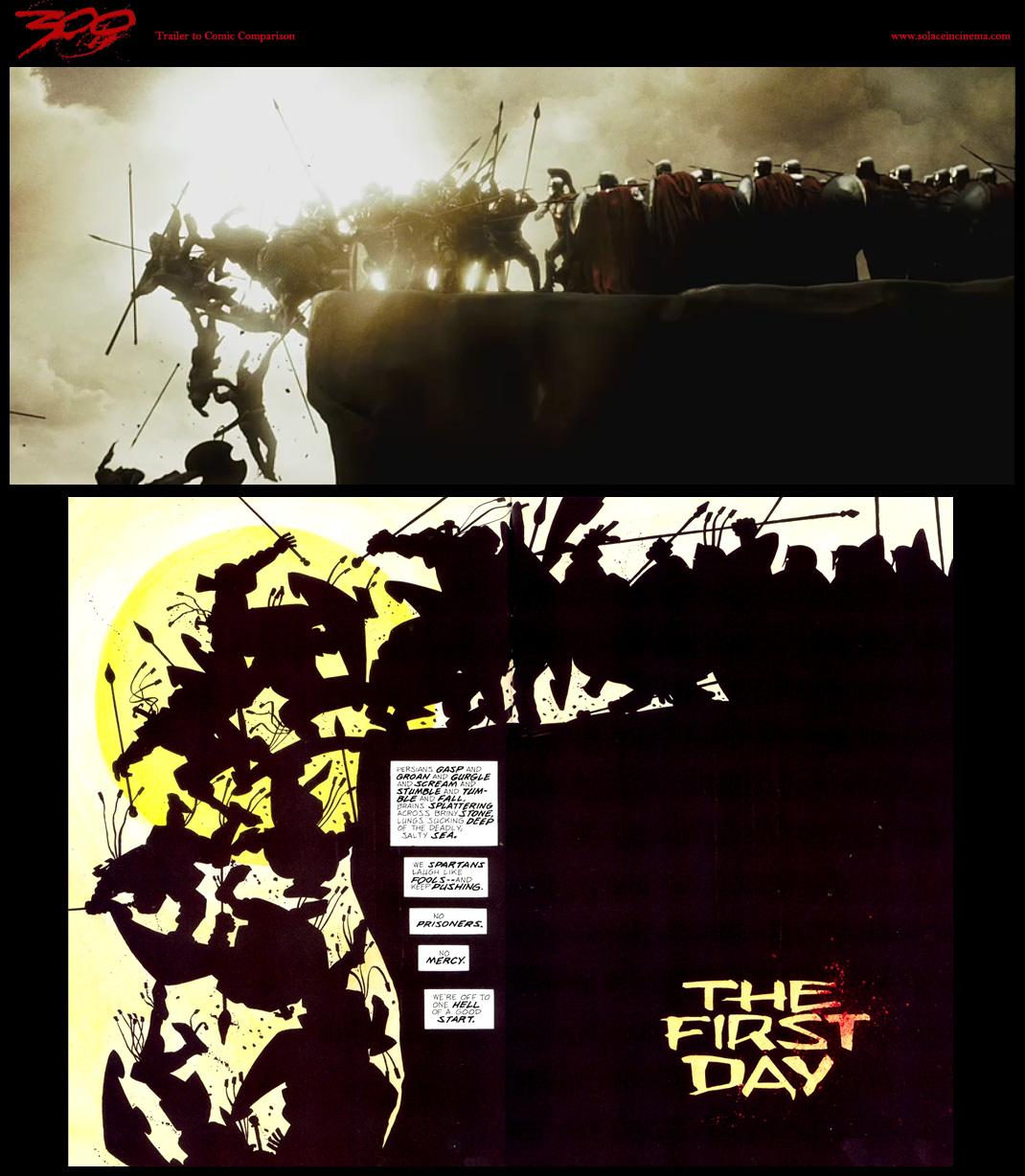
Unfortunately, these two critics imply that the film's similarity to the look and feel of video games (a medium enjoyed by more than just the core audience of younger males) limits the appeal of the film. This video game bias, perhaps related to the nearly constant criticism of the medium as an instigator of violence in adolescent boys, results in an ascription of stylized violence to video game culture. Thus, rather than judging the art of the film based on its aesthetic value, these critics decide to blame that which they don't like on a medium they seem neither to respect nor understand.
Perhaps more critics can appreciate the style of video games in film like Richard Roeper in the Chicago Sun Times:
"It is gorgeous to behold. It looks like the world's most sophisticated and expensive video game, and I mean that in a good way."
However, a few prominent critics have been sure to comment on the film's supposed video-game-like qualities: the fantastical computer-generated environments, stylized violence, and action-oriented plot, among others. Unfortunately, the comparisons of 300 to a video game tend to be pejorative rather than praising. Based on these seemingly passive and casual references to video games it is clear at least within the realm of cinema critique that video games are viewed as an inferior art form, and therefore a film which evokes the look and feel of a video game is inferior as well. For example, the LA Times author Kenneth Turan wrote, "unless you love violence as much as a Spartan, Quentin Tarantino or a video-game-playing teenage boy, you will not be endlessly fascinated." The New York Times's A.O. Scott said,
"I would happily pay a nickel less, in quarters or arcade tokens, for a vigorous 10-minute session with the video game that “300” aspires to become."
300 certainly does evoke the look and feel of a video game. Immediately, the immense, detailed, and eye-popping computer generated environments and characters evoke the feeling of an elaborate and massive video game. This is unsurprising, as similar technology is used to create both. However, many shots in 300, including those adapted from the graphic novel, resemble the close, over-the-shoulder look of 3rd-person action games. This is especially true in the film's battle scenes, which frequently follow one or two Spartans through poetically choreographed fights. The violence in the film is depicted, for lack of a better word, artistically--even when depicting brutal death, the film emphasizes the grace of the human body and the hypnotic appearance of fluid (in this case blood) in motion. While this may not necessarily be true for all video games, it is true that video games are designed to capture bodies in motion accurately and beautifully.
Unfortunately, these two critics imply that the film's similarity to the look and feel of video games (a medium enjoyed by more than just the core audience of younger males) limits the appeal of the film. This video game bias, perhaps related to the nearly constant criticism of the medium as an instigator of violence in adolescent boys, results in an ascription of stylized violence to video game culture. Thus, rather than judging the art of the film based on its aesthetic value, these critics decide to blame that which they don't like on a medium they seem neither to respect nor understand.
Perhaps more critics can appreciate the style of video games in film like Richard Roeper in the Chicago Sun Times:
"It is gorgeous to behold. It looks like the world's most sophisticated and expensive video game, and I mean that in a good way."
Subscribe to:
Posts (Atom)