Head over to www.kirschenbauminterview.blogspot.com to check out my final project for the class.
Thursday, April 26, 2007

Sunday, April 22, 2007
SPORE!
Could Spore be a more perfect game with which to end our course?
Doubtful.
Spore pushes the boundaries of a lot of the theories we've discussed so far. How about the admitted intertextuality of the game's many levels? Will Wright has compared each phase of the game to his "landmark" inspirations. The Cellular phase evokes images of "a fluid Pac-Man" as the player guides a small character eating dots in a 2-D environment. Spore Creature, a "first-person eater" has the player navigating a creature through a world of predators and prey fighting and eating for survival, compared by Wright to Diablo and the action-RPG's. Spore Tribal functions like a Real Time Strategy game, an animal version of Command and Conquer; Wright's own SimCity shows up as the player creates buildings and manages the beginnings of Spore Civilization, the world conquest game. Spore's space exploration phase, the broadest, most open, and most infinite phase, imitates god and space combat games.
Consider the 'T-shaped' structure of the game: linearly progressing from level to level until the sandbox level of interstellar space travel. On the superficial level, this combination of styles complicates the question of genre. How do we classify Spore, which has winning conditions for early levels, but no ending? Are we to conceive of Spore as a singular game, or as a network of interrelated games? Spore's player-controlled narrative beginning feeds into an open-ended gameplay universe. However, the emphasis does not appear to be concentrated on any one part.
One of the most impressive aspects of Spore is the in-game content generation system-- creatures, vehicles, buildings, and planets designed by players on in-game editors are distributed into player's games through a transparent content aggregation system. Paratextual elements which normally develop among niche fan communities are placed at the forefront of the game. But the interconnectivity of single players in Spore (called by Wright a "massively singleplayer online game") sets it apart from other games. The game not only aggregates user-generated content, but also learns and imitates the behaviors of all the players, offering players access to nearly infinite gaming possibilities, but not necessarily those possibilities delivered on the game disc.
Wright emphasizes the procedural nature of the game--establishing a set of encoded rules, the game reacts and responds to the inputs of the player producing unexpected and unpredictable results.
Of course, all this is based on the press and footage available on the internet. Even before the game has been released, it's reached legendary status. This unique fan culture around a text none have experienced first-hand presents a strange case of the paratextual fan network. That the game is built to maximize its contact with this fan-created culture promises that Spore could represent a move toward a reconceptualization of video games. Are we looking at video games 2.0?
Doubtful.
Spore pushes the boundaries of a lot of the theories we've discussed so far. How about the admitted intertextuality of the game's many levels? Will Wright has compared each phase of the game to his "landmark" inspirations. The Cellular phase evokes images of "a fluid Pac-Man" as the player guides a small character eating dots in a 2-D environment. Spore Creature, a "first-person eater" has the player navigating a creature through a world of predators and prey fighting and eating for survival, compared by Wright to Diablo and the action-RPG's. Spore Tribal functions like a Real Time Strategy game, an animal version of Command and Conquer; Wright's own SimCity shows up as the player creates buildings and manages the beginnings of Spore Civilization, the world conquest game. Spore's space exploration phase, the broadest, most open, and most infinite phase, imitates god and space combat games.
Consider the 'T-shaped' structure of the game: linearly progressing from level to level until the sandbox level of interstellar space travel. On the superficial level, this combination of styles complicates the question of genre. How do we classify Spore, which has winning conditions for early levels, but no ending? Are we to conceive of Spore as a singular game, or as a network of interrelated games? Spore's player-controlled narrative beginning feeds into an open-ended gameplay universe. However, the emphasis does not appear to be concentrated on any one part.
One of the most impressive aspects of Spore is the in-game content generation system-- creatures, vehicles, buildings, and planets designed by players on in-game editors are distributed into player's games through a transparent content aggregation system. Paratextual elements which normally develop among niche fan communities are placed at the forefront of the game. But the interconnectivity of single players in Spore (called by Wright a "massively singleplayer online game") sets it apart from other games. The game not only aggregates user-generated content, but also learns and imitates the behaviors of all the players, offering players access to nearly infinite gaming possibilities, but not necessarily those possibilities delivered on the game disc.
Wright emphasizes the procedural nature of the game--establishing a set of encoded rules, the game reacts and responds to the inputs of the player producing unexpected and unpredictable results.
Of course, all this is based on the press and footage available on the internet. Even before the game has been released, it's reached legendary status. This unique fan culture around a text none have experienced first-hand presents a strange case of the paratextual fan network. That the game is built to maximize its contact with this fan-created culture promises that Spore could represent a move toward a reconceptualization of video games. Are we looking at video games 2.0?
Tuesday, March 27, 2007
What makes a game "immersive"?
The term immersive is frequently thrown around when describing video games--especially by individuals not professionally engaged in scholarly study of games. From a genre standpoint, the term "immersive game" can be used interchangeably with alternate reality game (see Dave Szulborski's site/book) to refer to those cross media, collective intelligence performance/puzzle games. I do not, however, intend to delve into this form of gaming. I instead refer to the more informal adjectival form of the word, used to denote how "into" the game a player gets, or better yet, the degree to which the player's consciousness of interacting with a machine slips below his/her consciousness of being engaged in a game/story/world.
If we take this form of 'immersion' to mean the ease with which a player slips into the make believe of the video game--that events on the screen are just as real as events in the physical world (i.e., the actions of the player), then a few possibilities arise to help understand what makes a game immersive.
First, there are the obvious issues of human interface with the game--the heads up display, the load screens, and the analog to digital conversion of human action into virtual display. These issues offer very minor breaks or dampers to the immersiveness of a game--many players simply look past the interface displays and meters, while others remain fully aware of them, using them to succeed in the gameplay itself. Load screens and breaks in action can be forgotten or used as pacing mechanisms to give the game structure. Certain games which strip away these structures (in some cases as instances of cinema envy) can create a more immersive in game experience--not having to pause for a load screen or see gauges and meters enables the players to hone in on the action on screen, to more fully commit to the make believe of the game. In general, however, the immersiveness of a game seems to lie beyond the simple issue of human interface display--in fact, most gamers are completely used to the display as a given in video games, and still find themselves giving in to the imagined reality of the game.
"Immersive" is also a word frequently used to describe games with strong sensory appeal--the creation of realistic, or at least skillfully crafted sensory feedback. Well integrated visuals, music, sound effects, and haptic feedback all help to break down the "fourth wall" of the videoscreen and blend occurrences in the virtual and physical worlds. Users become surrounded (almost literally, in the case of Virtual Reality games) by sensory replications of the game world.
Further, games can be immersive in the imaginative (fictional?) worlds or universes that they create--for example, World Of Warcraft's systems of elves, dwarves, mages, skills, powers, abilities, quests, items, and magical beasts. Players devote themselves to the make believe of these worlds; fully aware that the locations and their rules are imagined, players accept them as an alternate virtual reality with which they are engaged. Players become immersed in the legend, lore, tips and tricks of the game not simply embedded in the software but as they flow out into the game's paratextual universe--the discussion boards, chat rooms, and devoted websites filled with player-created fictional and game-related content. Furthermore, fan fiction and designer-created fiction expands the boundaries of the fictional world of the game. Immersed players delve deeply not just into the storylines of the game, but into the full potential of the fictional gameworld.
But what about a rhythm game like Guitar Hero? The game lacks a storyline and has a limited fictional world--simply the creatively decorated stages unlocked by successfully playing increasingly difficult songs. Furthermore, the game has a very prominent visual interface; a guitar neck dominates the lower half of the screen, as colored circles representing notes to be played by pressing the corresponding guitar controller button descend to the bottom. But despite the interface and the very limited "game world," Guitar Hero is also a strongly immersive game experience. The controller, which is housed in a replica 3/4ths size guitar, consists of 5 fret buttons which must be held while pressing the strum bar, is a haptic simulation of playing a real electric guitar. When combined with the sensory experience of hearing music which corresponds with player action (including mistakes), the game becomes an immersive musical experience. The use of the whammy bar, which allows the player to add their own tremolo and note bends, simulates the feeling of producing a unique piece of music. Guitar Hero is immersive in the same way that using the Wiimote, light guns, steering wheels or flight joysticks imitates the haptic sensation of the real physical motion.
If we take this form of 'immersion' to mean the ease with which a player slips into the make believe of the video game--that events on the screen are just as real as events in the physical world (i.e., the actions of the player), then a few possibilities arise to help understand what makes a game immersive.
First, there are the obvious issues of human interface with the game--the heads up display, the load screens, and the analog to digital conversion of human action into virtual display. These issues offer very minor breaks or dampers to the immersiveness of a game--many players simply look past the interface displays and meters, while others remain fully aware of them, using them to succeed in the gameplay itself. Load screens and breaks in action can be forgotten or used as pacing mechanisms to give the game structure. Certain games which strip away these structures (in some cases as instances of cinema envy) can create a more immersive in game experience--not having to pause for a load screen or see gauges and meters enables the players to hone in on the action on screen, to more fully commit to the make believe of the game. In general, however, the immersiveness of a game seems to lie beyond the simple issue of human interface display--in fact, most gamers are completely used to the display as a given in video games, and still find themselves giving in to the imagined reality of the game.
"Immersive" is also a word frequently used to describe games with strong sensory appeal--the creation of realistic, or at least skillfully crafted sensory feedback. Well integrated visuals, music, sound effects, and haptic feedback all help to break down the "fourth wall" of the videoscreen and blend occurrences in the virtual and physical worlds. Users become surrounded (almost literally, in the case of Virtual Reality games) by sensory replications of the game world.
Further, games can be immersive in the imaginative (fictional?) worlds or universes that they create--for example, World Of Warcraft's systems of elves, dwarves, mages, skills, powers, abilities, quests, items, and magical beasts. Players devote themselves to the make believe of these worlds; fully aware that the locations and their rules are imagined, players accept them as an alternate virtual reality with which they are engaged. Players become immersed in the legend, lore, tips and tricks of the game not simply embedded in the software but as they flow out into the game's paratextual universe--the discussion boards, chat rooms, and devoted websites filled with player-created fictional and game-related content. Furthermore, fan fiction and designer-created fiction expands the boundaries of the fictional world of the game. Immersed players delve deeply not just into the storylines of the game, but into the full potential of the fictional gameworld.
But what about a rhythm game like Guitar Hero? The game lacks a storyline and has a limited fictional world--simply the creatively decorated stages unlocked by successfully playing increasingly difficult songs. Furthermore, the game has a very prominent visual interface; a guitar neck dominates the lower half of the screen, as colored circles representing notes to be played by pressing the corresponding guitar controller button descend to the bottom. But despite the interface and the very limited "game world," Guitar Hero is also a strongly immersive game experience. The controller, which is housed in a replica 3/4ths size guitar, consists of 5 fret buttons which must be held while pressing the strum bar, is a haptic simulation of playing a real electric guitar. When combined with the sensory experience of hearing music which corresponds with player action (including mistakes), the game becomes an immersive musical experience. The use of the whammy bar, which allows the player to add their own tremolo and note bends, simulates the feeling of producing a unique piece of music. Guitar Hero is immersive in the same way that using the Wiimote, light guns, steering wheels or flight joysticks imitates the haptic sensation of the real physical motion.
Sunday, March 18, 2007
Collective/Artificial Intelligence
I stumbled onto an interesting device a few months ago, which, in relation to our discussion of the collective intelligence embodied in the concept of Web 2.0 and the ilovebees ARG, seems interestingly relevant to our class. Google Talk, programmed by Google researcher Douwe Osinga and available on his website (unfortunately, the website is down at the moment of writing--check out his blog instead) generates text from Google search results. The user enters a phrase (usually the beginning of a sentence, like "A bird in the hand is") and the device completes the phrase with the most common subsequent word in the search results (in this case "worth"). After dropping the first word in the phrase, the device repeats the process infinitely, producing a potentially endless stream of 'consciousness' coming from Google searches. Indi Samarajiva's article about Onsinga's devices includes a pretty representative example of the device's output: beginning with "jesus will return," Google responded with "to Kings Associated Press July End did did Nature build the worlds largest Sex personals site!" The response indicates both the achievements and shortcomings of the device--it sometimes reveals how words are most frequently combined throughout the internet, in this case to advertise a pornographic personals site, but other times it produces random gibberish from the uncountable quantity of words on the Internet.
Osinga's device runs off the collected intelligence of the pages of the internet. Admittedly un-intelligent at this point, the device manages to generate text from the massive production of language by every contributor to the internet. It depends on the multi-user production of internet texts--the definitive quality of Web 2.0. Obviously, the device most successfully completes cliches because of their frequent use. However, in general, the device still produces intelligible language. In a way, the device allows Google to speak--it independently constructs new texts from limited user input. However, without the capacity to learn the rules of language from its continued inputs and outputs, the device will remain un-intelligent. In the attempt to create natural-language searches and user-interfaces in general, the ability to create unique verbal output in response to verbal input represents an important step toward mergent behavior. The goal, it seems, would be to creation Google dialogue--a technology which combines chat-bot and internet searching capability which can not only process natural language inputs, but produce natural language outputs from the searched documents. The interesting thing is that, by combining the user-created texts on searched websites into an approximate natural-language response, the device would potentially be putting individual users into a single dialogue with millions of web contributors. The device, if it could learn the appropriate behaviors, could possibly distill the collective intelligence of the internet into an artificial intelligence that "talks" to individual users.
Beyond the incredible potential for information gathering such an interface would create, it could represent a new step for the goal of AI--rather than programming all the processes of one human brain into a single computer, perhaps AI would process and reformat the collected human intelligence already found on the internet.
Osinga's device runs off the collected intelligence of the pages of the internet. Admittedly un-intelligent at this point, the device manages to generate text from the massive production of language by every contributor to the internet. It depends on the multi-user production of internet texts--the definitive quality of Web 2.0. Obviously, the device most successfully completes cliches because of their frequent use. However, in general, the device still produces intelligible language. In a way, the device allows Google to speak--it independently constructs new texts from limited user input. However, without the capacity to learn the rules of language from its continued inputs and outputs, the device will remain un-intelligent. In the attempt to create natural-language searches and user-interfaces in general, the ability to create unique verbal output in response to verbal input represents an important step toward mergent behavior. The goal, it seems, would be to creation Google dialogue--a technology which combines chat-bot and internet searching capability which can not only process natural language inputs, but produce natural language outputs from the searched documents. The interesting thing is that, by combining the user-created texts on searched websites into an approximate natural-language response, the device would potentially be putting individual users into a single dialogue with millions of web contributors. The device, if it could learn the appropriate behaviors, could possibly distill the collective intelligence of the internet into an artificial intelligence that "talks" to individual users.
Beyond the incredible potential for information gathering such an interface would create, it could represent a new step for the goal of AI--rather than programming all the processes of one human brain into a single computer, perhaps AI would process and reformat the collected human intelligence already found on the internet.


Sunday, March 11, 2007
The Stigma of the Video Game Aesthetic
Perhaps because it is so visually arresting, the recent Frank Miller graphic novel-film 300 has attracted the attention of moviegoers and critics. Generally, moviegoers seem to enjoy the film, as it skyrocketed to number one this weekend and could go on to be the biggest March opening ever. Personally, I left the theatre astounded and electrified by the gut-wrenching action, surreal visuals, and the general heroism of the plot. However, critics have given the film a mixed bag--some love it for the same reasons I did, others despise the graphic violence and sparse (spartan?) dialogue. Nearly all reviews I read contained some form of the caveat: the film is entertaining, mildly artistic, but unworthy of real respect. 300 has been variously lambasted for the acting, the surreal presentation of history, graphic content, and supposed homophobia/racism. Such things are to be expected about a movie so extremely different from what Hollywood has generated this year.
However, a few prominent critics have been sure to comment on the film's supposed video-game-like qualities: the fantastical computer-generated environments, stylized violence, and action-oriented plot, among others. Unfortunately, the comparisons of 300 to a video game tend to be pejorative rather than praising. Based on these seemingly passive and casual references to video games it is clear at least within the realm of cinema critique that video games are viewed as an inferior art form, and therefore a film which evokes the look and feel of a video game is inferior as well. For example, the LA Times author Kenneth Turan wrote, "unless you love violence as much as a Spartan, Quentin Tarantino or a video-game-playing teenage boy, you will not be endlessly fascinated." The New York Times's A.O. Scott said,
"I would happily pay a nickel less, in quarters or arcade tokens, for a vigorous 10-minute session with the video game that “300” aspires to become."
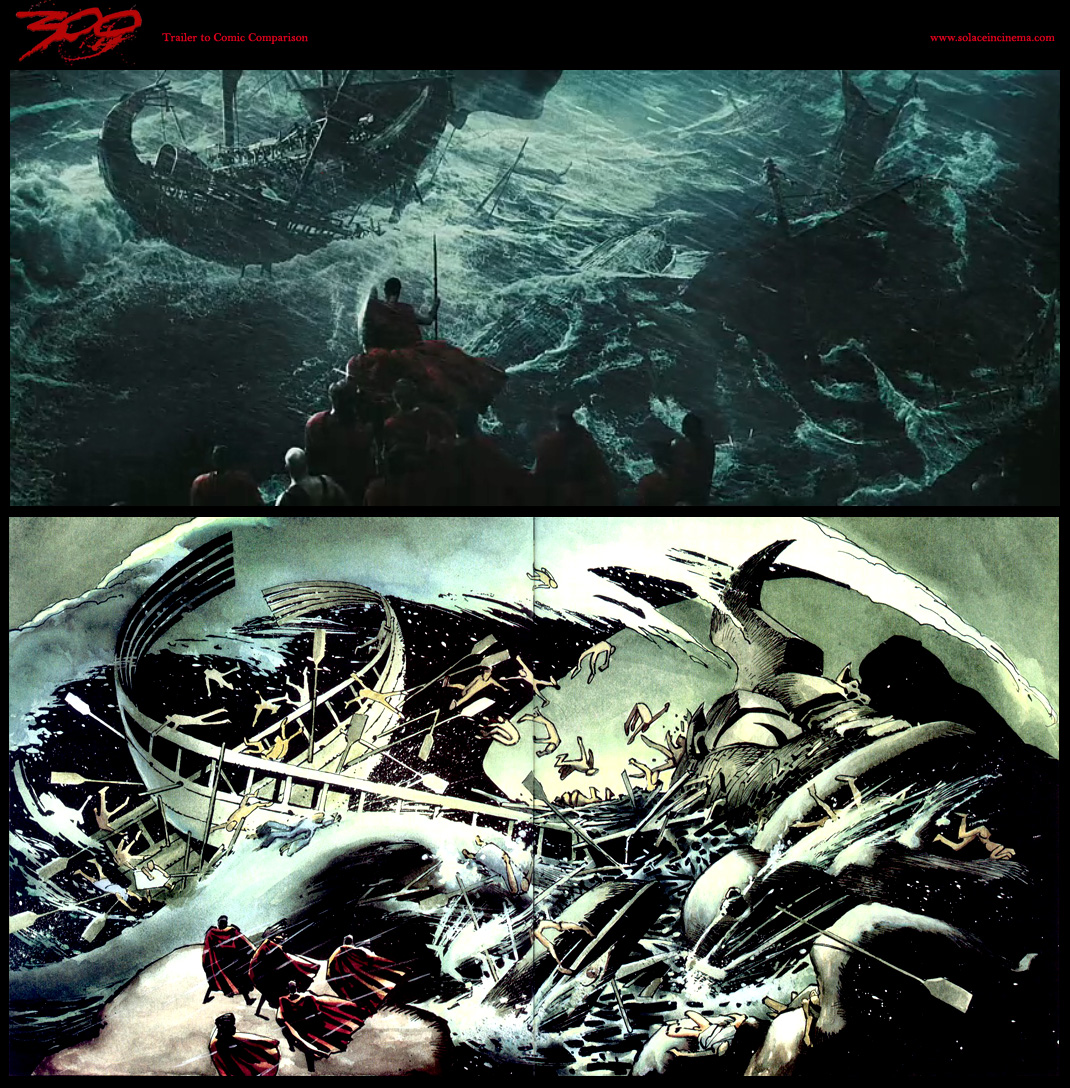
300 certainly does evoke the look and feel of a video game. Immediately, the immense, detailed, and eye-popping computer generated environments and characters evoke the feeling of an elaborate and massive video game. This is unsurprising, as similar technology is used to create both. However, many shots in 300, including those adapted from the graphic novel, resemble the close, over-the-shoulder look of 3rd-person action games. This is especially true in the film's battle scenes, which frequently follow one or two Spartans through poetically choreographed fights. The violence in the film is depicted, for lack of a better word, artistically--even when depicting brutal death, the film emphasizes the grace of the human body and the hypnotic appearance of fluid (in this case blood) in motion. While this may not necessarily be true for all video games, it is true that video games are designed to capture bodies in motion accurately and beautifully.
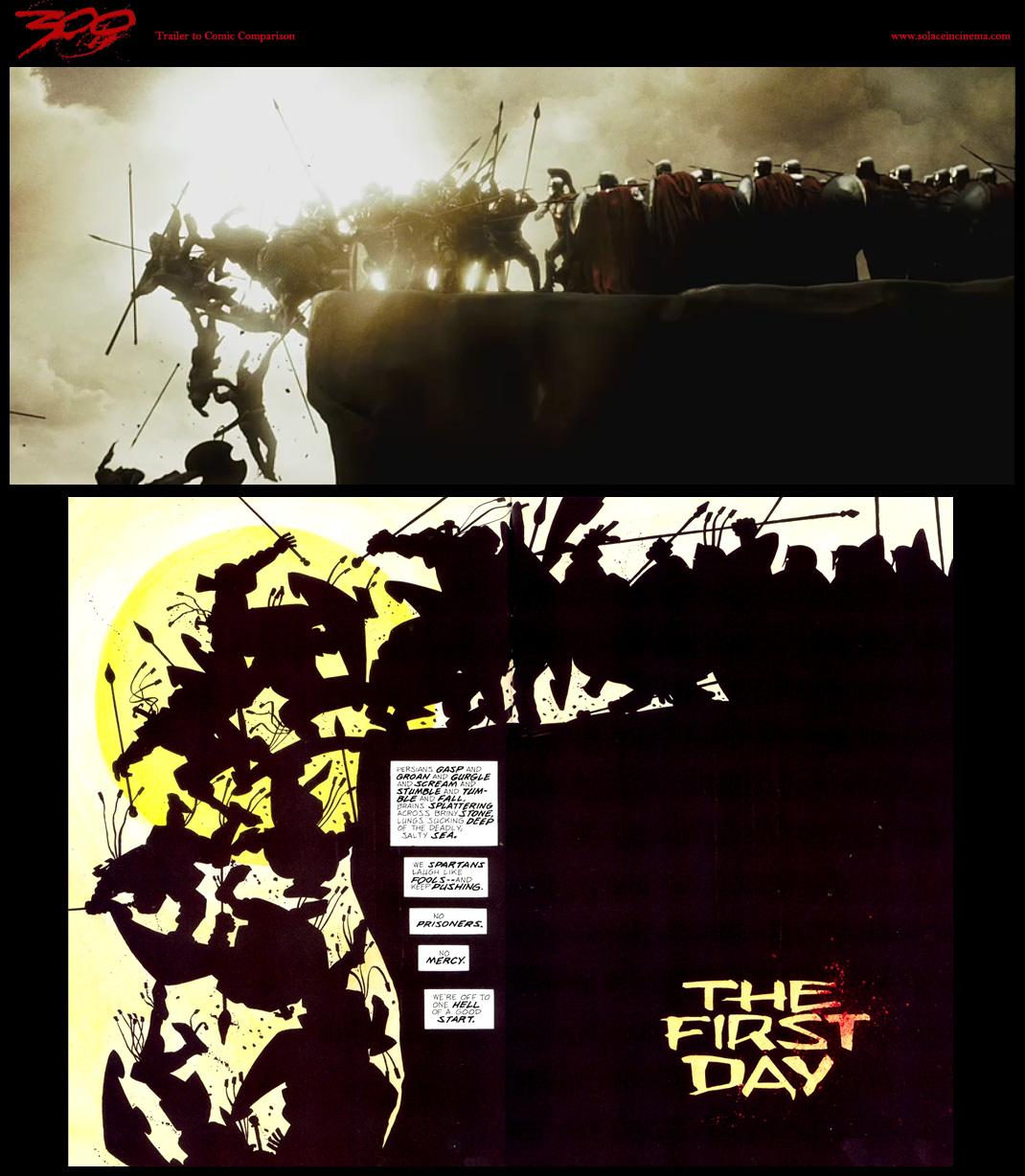
Unfortunately, these two critics imply that the film's similarity to the look and feel of video games (a medium enjoyed by more than just the core audience of younger males) limits the appeal of the film. This video game bias, perhaps related to the nearly constant criticism of the medium as an instigator of violence in adolescent boys, results in an ascription of stylized violence to video game culture. Thus, rather than judging the art of the film based on its aesthetic value, these critics decide to blame that which they don't like on a medium they seem neither to respect nor understand.
Perhaps more critics can appreciate the style of video games in film like Richard Roeper in the Chicago Sun Times:
"It is gorgeous to behold. It looks like the world's most sophisticated and expensive video game, and I mean that in a good way."
However, a few prominent critics have been sure to comment on the film's supposed video-game-like qualities: the fantastical computer-generated environments, stylized violence, and action-oriented plot, among others. Unfortunately, the comparisons of 300 to a video game tend to be pejorative rather than praising. Based on these seemingly passive and casual references to video games it is clear at least within the realm of cinema critique that video games are viewed as an inferior art form, and therefore a film which evokes the look and feel of a video game is inferior as well. For example, the LA Times author Kenneth Turan wrote, "unless you love violence as much as a Spartan, Quentin Tarantino or a video-game-playing teenage boy, you will not be endlessly fascinated." The New York Times's A.O. Scott said,
"I would happily pay a nickel less, in quarters or arcade tokens, for a vigorous 10-minute session with the video game that “300” aspires to become."
300 certainly does evoke the look and feel of a video game. Immediately, the immense, detailed, and eye-popping computer generated environments and characters evoke the feeling of an elaborate and massive video game. This is unsurprising, as similar technology is used to create both. However, many shots in 300, including those adapted from the graphic novel, resemble the close, over-the-shoulder look of 3rd-person action games. This is especially true in the film's battle scenes, which frequently follow one or two Spartans through poetically choreographed fights. The violence in the film is depicted, for lack of a better word, artistically--even when depicting brutal death, the film emphasizes the grace of the human body and the hypnotic appearance of fluid (in this case blood) in motion. While this may not necessarily be true for all video games, it is true that video games are designed to capture bodies in motion accurately and beautifully.
Unfortunately, these two critics imply that the film's similarity to the look and feel of video games (a medium enjoyed by more than just the core audience of younger males) limits the appeal of the film. This video game bias, perhaps related to the nearly constant criticism of the medium as an instigator of violence in adolescent boys, results in an ascription of stylized violence to video game culture. Thus, rather than judging the art of the film based on its aesthetic value, these critics decide to blame that which they don't like on a medium they seem neither to respect nor understand.
Perhaps more critics can appreciate the style of video games in film like Richard Roeper in the Chicago Sun Times:
"It is gorgeous to behold. It looks like the world's most sophisticated and expensive video game, and I mean that in a good way."
Friday, February 23, 2007
The tools of the game
Regarding our recent foray into machinima, I found most interesting the use of the rules and mechanics of games like Halo in unintended ways. In a way, shows like This Spartan Life and Red vs. Blue resemble literary fan fiction--they elaborate on the primary text in a creative way which expands the possibility of the created world. These tributes essentially borrow the world built by the writer/creators and rearrange certain elements, speculate on previously established characters, and even imitate the mechanics of the original author's writing style. However, machinima seems to go farther than fan fiction in its creative activity while taking place inside the very same game world in which the creators built their text. The software with which machinima creators film their shows/movies is the very same software that the gamebuilders turn over to a publisher. The creation of machinima requires rearrangement of game elements, selective use of in-game environments, and manipulation of provided software scripts (e.g. physics engines). A fan fiction writer cannot engage in the same manipulation of the story world because the written storyworld is not so fluid as the video game's. The written story world is defined by the linear narration by the author, and is limited to the boundaries presented within the pages of the book(s) which describe it. The video game storyworld, by contrast, is a more dynamic engine, which includes the traditional story elements, but also includes massive visual environments, artificial intelligence rules, and virtually constructed physical boundaries (physics engines, "invisible walls", etc.) The game storyworld is dynamic and an engine in the sense that it is constantly reacting to the actions of the player, in a recurring act of creation which never stops "building" the world occupied by the player's avatar. Horizon fog (a staple of many games) which obscures the gamespace and helps to create a sense of distance on the 2-D game screen, reveals the dynamic nature of the game engine--as the player advances, horizon fog dissolves into scenery, or more literally, undefined pixels are converted into mapped gamespace. Even in games without horizon fog, the simple act of movement by the character requires active mapping by the game software to reveal parts of the gamespace previously outside of the player's view on the screen.
In addition to manipulating the virtual world created by the primary text, machinimists even have the ability to transform that world into something entirely different. On the small scale, Red vs. Blue and This Spartan Life rewrite the rules of Halo's fictional universe--they change locations written into the game world into something more useful for their creative fiction. For example, a medical tent in Halo could become a dog house or a camping tent or a speaker's podium in a work of machinima. In the case of Red vs. Blue, Master Chief can be transformed from a relatively ambiguous and nameless avatar into several recognizable characters (when paired with the differentiated voices of the creators/actors). On a larger scale, players of Half Life 2 using Garry's Mod (a "sandbox mode" which allows players to conjure, manipulate, arrange, and change game elements in an open space) almost have the ability to create new worlds--ones with half-gravity, watermelon guns, and carefully arranged ragdoll characters.
In some cases, machinima essentially builds new worlds. However, this activity requires, in addition to using the provided software and game elements, the same creative writing as fan fiction. The world of Red vs. Blue is a mixture of the Halo world and the Rooster Teeth world--it is a mixture of rules established by the two creator groups. Thus, machinima can serve the same role as literary fan fiction, but the dynamic virtual worlds created by video games permits a much broader capability to create new worlds from the inherited text.
I'm curious to hear what anyone thinks about my conclusions--does my differentiation of fan fiction and machinima go too far or not far enough? Is machinima, counter to my argument, more constrained by the inheritance of the game's rules?
In addition to manipulating the virtual world created by the primary text, machinimists even have the ability to transform that world into something entirely different. On the small scale, Red vs. Blue and This Spartan Life rewrite the rules of Halo's fictional universe--they change locations written into the game world into something more useful for their creative fiction. For example, a medical tent in Halo could become a dog house or a camping tent or a speaker's podium in a work of machinima. In the case of Red vs. Blue, Master Chief can be transformed from a relatively ambiguous and nameless avatar into several recognizable characters (when paired with the differentiated voices of the creators/actors). On a larger scale, players of Half Life 2 using Garry's Mod (a "sandbox mode" which allows players to conjure, manipulate, arrange, and change game elements in an open space) almost have the ability to create new worlds--ones with half-gravity, watermelon guns, and carefully arranged ragdoll characters.
In some cases, machinima essentially builds new worlds. However, this activity requires, in addition to using the provided software and game elements, the same creative writing as fan fiction. The world of Red vs. Blue is a mixture of the Halo world and the Rooster Teeth world--it is a mixture of rules established by the two creator groups. Thus, machinima can serve the same role as literary fan fiction, but the dynamic virtual worlds created by video games permits a much broader capability to create new worlds from the inherited text.
I'm curious to hear what anyone thinks about my conclusions--does my differentiation of fan fiction and machinima go too far or not far enough? Is machinima, counter to my argument, more constrained by the inheritance of the game's rules?
Thursday, February 15, 2007
Where is the Second Life epitext?
When discussing a single-player game, the definition of its paratexts (Genette) seems relatively straightforward. The peritext--those thresholds between the game-world and the real-world which are attached to the game's "body" itself--can take the form of packaging, cover art, reviews and ratings on the box, the manual and/or story booklets inside it, and even the in game user interface, self-conscious tutorials, and title sequences or credits. The epitext--those thresholds which exist outside immediate proximity to the text--can take the form of marketing devices, game reviews, creator interviews, walkthroughs, cheat code websites, and online player forums. These epitexts, created by the media, the game creators, or the game players significantly alter the reception of the game from outside of the game world (hence, they fall under the category of paratexts). Significantly differing from peritext, the epitext seems to be more fully self-conscious of its outside-the-text status. Peritexts, especially in-game, are frequently slipped in quietly, in an attempt to integrate smoothly with actual gameplay, which comprises the primary text. Other peritexts, like packaging, reviews, ratings, etc. are usually well-established video game conventions provided by producers and expected by consumers to help them place the game within a conceptual framework and develop specific desired (by the producer) expectations of what the game offers. Epitext, however, remains conscious of and even emphasizes the fact that it is created as an addition to the game, and must be sought out, transacted, or buffered through crossings of media.
A massively multiplayer online world, like Second Life, has many obvious epitexts that seem to embrace the traditional definition--just look at the feverish press coverage of the activities of real world businesses within Second Life's "virtual economy." Because players can purchase land, goods, and services, real corporations have flocked to the virtual world to hawk computer versions of their products for real money (translated into linden dollars). Back to epitexts, however. This press coverage, while chronicling the experience of gameplay and shaping perceptions for both players and onlookers, still exists well outside the body of the game itself--it exists in another medium and is sought out by the viewer rather than included in the game. Thus, it is firmly epitextual.
But what about a text which is user-created within the game itself? In Second Life, users can create (and sell) pretty much anything they want. So what if a Second Life player writes a song or a guide to buying and selling real estate in Second Life and sells that text to another player in Second Life. What about a chat between two users, one offering help to another? Because this all occurs in Second Life, complications arise. Should this user created text be considered in or out of the game--epitext, peritext, or pure text? The complicating factor is that user-creation and user-interaction lies at the very core of the Second Life gameplay experience. The purpose of the game is to allow players a venue in which to act out whatever fantasies (within the game's framework) they wish to pursue. The most strict definition of the game, then, would be the virtual space, tools, and network in which users build and manipulate freely. What a user creates is not a product of Linden Labs, although it is an intended result of the game. Thus, the question returns, how do we categorize these products?
Because they exist within the gamespace, it is tempting to call user-created objects"texts" proper--they are the intended results of gameplay in the form of codes running within the overall frame of Second Life. However, in the case of songs or linguistic texts (as opposed to virtual objects like clothes), it seems more accurate to call user-created media within the Second Life universe epitext. Unlike game objects, which must exist in code, linguistic texts inside Second Life can and conceivably do cross the threshold of Second Life and take on an existence in the "real world" -- for example, on a user's hard drive, as a text file. The user created texts, self aware of their user authorship and non-Linden Lab authorship, are similar to epitexts in that their intention, creation, and interpretation are connected to Second Life, but not integrated into it. Second Life objects, by contrast, are produced within the software framework and their existence is limited to that virtual universe. They are therefore more similar to peritexts. (If Second Life objects had another universe in which to exist, i.e., if they could be ported into other forms, perhaps they too could be considered epitextual).
The qualifying condition for all of my claims is that I am defining the primary text--the gameplay of Second Life--as the virtual space and tools which users implement to shape their game experience. While user-creation is an integral goal and purpose of the game, the objects created by users cannot be predicted or controlled, only permitted, by the rules of the game. Thus, the software oriented objects, which do not inherently alter the overarching structure (universal rules) of Second Life, but are attached (via code) to the universe, more closely resemble paratext. Alternately, creative objects within the game which do not require more than a superficial coding to enter the game and have some sort of external existence more closely resemble epitext. However, complications abound, and at this point, only careful research into the modes of existence for different user-created "texts" will help to confirm these propositions. The material origins of the term "paratext" may need to be altered in order to help explain the relationship between these objects and the game vs. real worlds.
A massively multiplayer online world, like Second Life, has many obvious epitexts that seem to embrace the traditional definition--just look at the feverish press coverage of the activities of real world businesses within Second Life's "virtual economy." Because players can purchase land, goods, and services, real corporations have flocked to the virtual world to hawk computer versions of their products for real money (translated into linden dollars). Back to epitexts, however. This press coverage, while chronicling the experience of gameplay and shaping perceptions for both players and onlookers, still exists well outside the body of the game itself--it exists in another medium and is sought out by the viewer rather than included in the game. Thus, it is firmly epitextual.
But what about a text which is user-created within the game itself? In Second Life, users can create (and sell) pretty much anything they want. So what if a Second Life player writes a song or a guide to buying and selling real estate in Second Life and sells that text to another player in Second Life. What about a chat between two users, one offering help to another? Because this all occurs in Second Life, complications arise. Should this user created text be considered in or out of the game--epitext, peritext, or pure text? The complicating factor is that user-creation and user-interaction lies at the very core of the Second Life gameplay experience. The purpose of the game is to allow players a venue in which to act out whatever fantasies (within the game's framework) they wish to pursue. The most strict definition of the game, then, would be the virtual space, tools, and network in which users build and manipulate freely. What a user creates is not a product of Linden Labs, although it is an intended result of the game. Thus, the question returns, how do we categorize these products?
Because they exist within the gamespace, it is tempting to call user-created objects"texts" proper--they are the intended results of gameplay in the form of codes running within the overall frame of Second Life. However, in the case of songs or linguistic texts (as opposed to virtual objects like clothes), it seems more accurate to call user-created media within the Second Life universe epitext. Unlike game objects, which must exist in code, linguistic texts inside Second Life can and conceivably do cross the threshold of Second Life and take on an existence in the "real world" -- for example, on a user's hard drive, as a text file. The user created texts, self aware of their user authorship and non-Linden Lab authorship, are similar to epitexts in that their intention, creation, and interpretation are connected to Second Life, but not integrated into it. Second Life objects, by contrast, are produced within the software framework and their existence is limited to that virtual universe. They are therefore more similar to peritexts. (If Second Life objects had another universe in which to exist, i.e., if they could be ported into other forms, perhaps they too could be considered epitextual).
The qualifying condition for all of my claims is that I am defining the primary text--the gameplay of Second Life--as the virtual space and tools which users implement to shape their game experience. While user-creation is an integral goal and purpose of the game, the objects created by users cannot be predicted or controlled, only permitted, by the rules of the game. Thus, the software oriented objects, which do not inherently alter the overarching structure (universal rules) of Second Life, but are attached (via code) to the universe, more closely resemble paratext. Alternately, creative objects within the game which do not require more than a superficial coding to enter the game and have some sort of external existence more closely resemble epitext. However, complications abound, and at this point, only careful research into the modes of existence for different user-created "texts" will help to confirm these propositions. The material origins of the term "paratext" may need to be altered in order to help explain the relationship between these objects and the game vs. real worlds.
Monday, February 5, 2007
Note to self: Lite Brites scare old people


Viral and non-traditional marketing campaigns are slowly approaching the mainstream as a growing segment of the population becomes more comfortable with the non-traditional media which is emerging from our computer screens, cell phones/PDAs, iPods, and (once they have lost most of their "cool-factor") TV screens. Many consumer goods, like cars, shampoo, and even tupperware (on of the primary non-digital forms of viral marketing) build campaigns around word of mouth to generate interest in the products without engaging in traditional TV and Print ad campaigns. These firms typically create some sort of "real world" experience through which to bridge the gap between marketing and the everyday lives of potential customers. In simple cases, these events occur in friends' homes. However, as media delivery systems become more sophisticated and varied, the firms are able to generate audio, video, or visual artifacts which are delivered in quiet and spread through the marketplace via word of mouth. In some cases, like the now infamous Aqua Teen Hunger Force lightboard campaign, these viral marketing tactics take the form of seemingly inexplicable signs, art installations, or public displays.
Tuesday, January 23, 2007
To Whom Does a Text Belong?
On Tuesday we discussed W.H. Auden's September 1, 1939, a Modernist poem which has had an interesting textual history. Written on the occasion of Germany 's invasion of Poland , it's been constantly reinterpreted and regenerated, but especially so after September 11, 2001, due to its allusions to New York City
Auden’s attempts to alter his text and limit its consumption after the initial production raise difficult questions about the nature of the text. To whom does the text belong? Is there ever a transfer of ownership from writer to publisher and even to reader? If so, when does this transfer occur?
Many assume that the text belongs to an author in eternity—which, to an extent, it does. The poem is attributed to the author who, according to our system of laws, has at least some right to control its usage. However, a text cannot be manufactured without a publisher or editor who in many cases makes significant decisions about both dialectic and physical attributes of the text: excise/inclusion and arrangement of lines, use of punctuation, typeface, location on the page, binding, cover, etc. This is a more obvious aspect of the shared ownership of a text.
Nevertheless, once the poem enters the public sphere to be disseminated, interpreted, and regenerated, the readers themselves might claim some ownership, especially of the ways the poem can be read—in the context of papers, theses, discussions, and redistribution, the readers can be the most important determinants in what the text comes to mean. This is especially true in the case of internet publication. The internet allows for instantaneous and unregulated redistribution of a work, often enabling the reinterpretations and regenerations of the poem. For example, would the increased popularity and reinterpretation of Auden’s September 1, 1939 after 9/11 have occurred without the use of the internet and e-mail? It seems unlikely.
If both publishers and readers at the very least seem to have some ownership claim on a text, the question remains, “to whom does a text belong?” Does the author reserve the right to alter a text one, ten, even fifty years after publication? Such revisions aren’t so uncommon—for example, when studying Frankenstein, we read either Shelley’s 1818 or her 1831 edition. Even in other media, such as film, revisions can have significant and often unintended interpretive effects on the text. For example, in Stephen Spielberg’s 2002 re-release of E.T., The Extra-Terrestrial, among other edits, a policeman’s shotgun is replaced with a radio due to Spielberg’s discomfort with the image of police brandishing guns near children. However, for many viewers, this edit awkwardly draws attention to itself—a computerized replacement for a filmed object which for many would have been insignificant were it left alone. Though Spielberg owns the legal right to do with his text whatever he wishes, his editing results in a regeneration of the film’s meaning by its viewers. Now viewers watch the film conscious of its 2002 alterations—supposed “improvements” which many believe damage the quality of the original. So, was Spielberg’s alteration justified? Does he still reserve the right to revise his movies, even when its distribution, interpretation, and regeneration now occurs almost exclusively in the homes of its viewers?
When it comes to video games as texts, the question of ownership is even more complicated. Arguably, there is no unified "author," but a team of writers, designers, and programmers working together. Furthermore, the text is disseminated through a specific gaming platform, becoming a part of a nexus of associated games, thereby altering the nature of its interpretation. So, in a way, the platform manufacturer can claim some ownership of the text and the way it's understood. And, finally, by placing the text in the hands of a user who in many cases determines how, when, and to what extent the narrative unfolds, the specific experience of a single player results in a unique text. Finally, as a medium designed for entertainment, which attempts to create fun for the player rather than achieving an agenda for expression by an author, the game's purpose seems to be weighted away from the creator and toward the player. So, like other texts, the question of ownership of video games is complicated and frequently inscrutable.
Wednesday, January 17, 2007
Mystified

Well, I went to the library to find the reserve text for tomorrow, but was informed that it was unavailable. Apparently it’s been checked out from the Lewis Library, and the
But what significance do the books in Myst hold? Books, or more appropriately, texts, are the only form of human contact offered to the player as he or she attempts to unlock the secrets of this bleak and disconcertingly empty world. The texts in Myst (signs, diagrams, books, etc.) are the only means by which players can advance through the game, providing the necessary information to unlock the puzzles scattered throughout the world of Myst, and acting as portals to other worlds. By turning the figurative concept of a book as an invented world literally into another world, Myst expands the possibilities of texts. Texts contain worlds, people (Atrus, Achenar, and Sirrus), images, and of course, language. However, they carry with them more meaning than simply the words contained in them. Their varying physical conditions reveal information about their backgrounds and histories, and their relationships to one another do more than the words alone to reveal the underlying “plot” of Myst. In fact, the “plot” of Myst seems to actually be the story of the books in the library. It will be interesting to finally learn how all of the books interconnect, when and how they were written, and what they mean as a collection.
Subscribe to:
Posts (Atom)